
Mongolia’s paradox of poverty amid abundant resources continues. In my writings I captured the reality exactly: “State-owned enterprises (SOEs) now exceed one hundred in number, with roughly one-third operating at a loss, sucking resources from the state budget and crowding out private investment. Keeping energy prices artificially low through subsidies distorts investment signals and widens the budget deficit.”
Current State of Mongolia’s SOEs As of 2025, Mongolia has 109 state-owned and state-participated enterprises. Nearly one-third — 43 companies — are chronically loss-making, many for three consecutive years, with balance sheets deep in the red. In 2024, these SOEs generated ₮26 trillion in revenue, yet their combined debt nearly doubled to ₮11 trillion. This amount equals roughly one-third of the 2026 national budget (₮32.9 trillion) and accounts for 24 percent of total public debt. The energy sector remains the biggest “cash drain”: subsidised tariffs force utilities to run at losses that are routinely covered by the state budget. The tariff adjustment in November 2024 was a welcome step, but it has not yet eliminated the quasi-fiscal deficit.
Why Are They So Inefficient? The causes are structural and deeply political. Private companies are driven by profit and competition, whereas SOEs operate under soft budget constraints — losses are routinely covered by taxpayers or hidden through off-balance-sheet guarantees. Management and board positions are often filled through political patronage rather than competence. In critical sectors such as energy, transport, and mining, the lack of competition removes any pressure to cut costs or innovate. Energy subsidies distort investment signals, deter private capital, and turn the state into a perpetual cash cow. The result is a vicious cycle: SOEs drain the budget, stifle private-sector growth, and increase the vulnerability of an economy overly dependent on volatile mining revenues.
Big Promises, Zero Delivery: SOEs as a Political Cash Machine Since the 1990s every government has promised SOE reform and privatisation, yet the number of loss-making companies has only increased. Early voucher privatisation gave some assets to citizens, but strategic enterprises remained under state control. Successive administrations have repeatedly announced plans — most recently pledging to privatise 18–20 SOEs by 2028 through the Mongolian Stock Exchange (MSE), selling 10–66 percent stakes to raise ₮3.7 trillion. The holding company “Erchist Mongol”, created to manage 44 energy firms, has failed to deliver any meaningful change and now lies dormant.
The reason is simple: SOEs have become reliable cash-flow machines for ruling parties and bureaucrats. They provide jobs for loyalists, lucrative contracts for connected businesses, opaque procurement deals, and dividends that quietly finance political networks. This powerful interest group — politicians, senior officials, and insiders — fiercely resists real reform, turning every promise into electoral theatre.
Proven International Success Stories This deadlock can be broken through bold privatisation. A standout example is British Airways under Margaret Thatcher. In the early 1980s, BA was a heavily loss-making, overstaffed state carrier. On 11 February 1987, its shares were offered to the public on the London Stock Exchange and were oversubscribed 11 times. After privatisation, staff numbers fell while passenger numbers soared, on-time performance improved dramatically (from around 70% to 85%), and customer complaints halved. BA transformed into one of the world’s most profitable and respected airlines, famously known as “The World’s Favourite Airline.”
Other successes include New Zealand’s corporatisation and privatisation programme, which turned loss-making SOEs into profitable enterprises; Chile’s power sector reforms that halved losses and attracted massive private investment; and Kenya’s partial IPOs of KenGen and Safaricom, which boosted efficiency and capital-market development. Even in Mongolia, the partial listing of Mongol Post has demonstrably improved governance and market valuation.
The Way Forward for Mongolia Listing SOE stakes on the Mongolian Stock Exchange can deliver multiple benefits at once: attracting private capital and professional management, imposing market discipline through shareholder oversight, giving ordinary citizens real ownership, and deepening the domestic capital market. In strategic sectors the state can retain a golden share. Essential complementary reforms include moving energy prices to full cost-recovery levels, establishing genuinely independent boards, strengthening corporate governance laws, and rigorous fiscal risk monitoring by the Ministry of Finance.
If implemented transparently and free of corruption through the MSE, these measures would turn loss-making “cash cows” into engines of growth. Former SOEs would stop bleeding the budget, freeing resources for health, education, and infrastructure, while unlocking private investment in energy and logistics.
Mongolia cannot afford another decade of half-measures. Reforming SOEs is not merely an economic necessity — it is the foundation for fiscal independence, private-sector vitality, and long-term national prosperity.
It is time for quick decision and act faster.
On December 16, 2025, the Government of Mongolia decided to submit the draft Law on Economic Freedom to Parliament. Given the fundamental nature of economic freedom, this initiative has understandably drawn public attention. In a democratic society, such a foundational law should not be adopted without broad public understanding and debate. What, then, does “economic freedom” actually mean—and does the current draft truly reflect it?
Put simply, economic freedom means that citizens and businesses have the right to decide for themselves what to produce, how to produce it, and at what price to sell it—using their own property, labor, and capital—without having to seek permission from the state. If they make a profit, they enjoy it; if they incur losses, they bear them. In other words, economic decisions are made by individuals and markets, not by government officials.
Economic freedom, however, is often misunderstood. It is not about the state “regulating business well,” fixing prices, providing subsidies, or intervening in markets to “stabilize” outcomes. These are all forms of state intervention. Economic freedom is based on the opposite principle: the deliberate limitation of state involvement in market activity. In a free-market system, the state is not a market participant but a rule-keeper.
From this perspective, the current draft law raises serious questions. Although it is titled a law on economic freedom, its underlying logic still reflects a soft interventionist mindset—the belief that “if the state regulates well, business will thrive.” For example, the draft explicitly allows the state to participate in and finance sectors such as education, healthcare, infrastructure, public services, and technological solutions. This keeps the government firmly positioned as an economic actor rather than a neutral arbiter. As a result, the boundary between the state and the private sector remains blurred, increasing the risk of corruption and conflicts of interest.
If Mongolia genuinely aims to build a fully free economy, the law must clearly prohibit the state from engaging in activities that the private sector can perform under market conditions. General statements about “reducing state involvement” are insufficient. What is needed is a clear rule, such as: the state shall not engage in any economic activity that can be carried out by private enterprise in a competitive market. Only such clarity can impose a real limit on state power.
Another major omission in the draft law is the absence of any principle regarding price freedom. There is no reference to prices, wages, tariffs, or exchange rates. Yet prices are the core signals of a market economy, and exchange rates reflect risk and responsibility. When governments interfere in price-setting, markets receive false signals, leading to shortages, shadow markets, and rent-seeking. A genuine law on economic freedom must explicitly state that prices, wages, tariffs, and exchange rates are determined by free market interactions, and that direct or indirect state interference is prohibited.
Equally troubling is the lack of a clear upper limit on regulatory power. Broad and vague concepts such as “national security” or “public interest” are left undefined, allowing almost any restriction to be justified. This undermines predictability and investor confidence. Any limitation on economic freedom should meet strict criteria: it must be necessary, minimal, time-bound, and subject to judicial review. Without these safeguards, economic freedom exists only on paper.
True economic freedom also requires a clear prohibition on state-run commercial activity. The state should not operate businesses for profit. Instead, state-owned enterprises, projects, and programs should be reduced, privatized, or transferred to competitive markets. Otherwise, the government remains a dominant competitor—one that enjoys regulatory power over its own rivals.
A genuine law on economic freedom should therefore include a specific article defining the state’s core economic role. That role should be limited to protecting life and property, ensuring environmental safety, enforcing contracts and property rights through the courts, and safeguarding fair competition. Beyond these functions, the state should not engage in economic activity. This concept is widely known as the “night-watchman state”—a government that protects the rules of the game without playing it.
Mongolia’s recent economic challenges provide strong justification for such reform. Slowing growth, declining investment, and an increasingly unpredictable business environment are closely linked to excessive state intervention, overlapping regulations, and the expanding burden of licenses and permits. Partial adjustments are no longer sufficient. What is needed is a structural shift—a legal foundation that firmly anchors the economy in free-market principles.
In conclusion, economic freedom is not about better state control. It is about abandoning the logic of “the state decides” and embracing the principle that the state protects, while the market decides. If the Law on Economic Freedom is to live up to its name, it must serve as a constitutional-level guarantee of free markets—one that clearly limits government power and fully liberates private enterprise.
Finally, taking the country’s realities into account, Mongolia cannot abruptly and completely withdraw state involvement from the education and healthcare sectors. Therefore, these sectors should be managed not by the state alone, but through a productive partnership with the private sector, gradually expanding competition and choice in a phased and responsible manner.
Countries have traditionally measured their economic development through Gross Domestic Product (GDP). The per capita GDP of Mongolia, indicating the living standards of its citizens, was USD 6,000 in 2023, and is forecasted to be USD 6,800 in 2024, and projected to reach USD 10,000 by 2028, according to a recent statement by the Prime Minister L. Oyun-Erdene. If realized, Mongolia will move up from its current rank of 104th out of 190 countries to be among the top eighty. To accomplish this, the country must have 14 mega projects fully started by 2026. Then, how can we accurately gauge the influence of these projects on the nation’s economic trajectory?
Keynes and Say
GDP is the sum of household, business, and government final expenditure in a given year. (Y = C + I + G + (X − M): GDP (Y) is the sum of consumption (C), investment (I), government Expenditures (G) and net exports (X − M). Consumption (C + G) constitutes two-thirds of GDP, so many believe that consumption is the main driver of the economy. The higher the consumption or demand, the greater the supply (demand creates supply), and thus, Keynesian economists (following British economist J.M. Keynes (1883-1946)) support increased government spending. Left-leaning and center-left political forces endorse this view.
However, the economy is driven not only by final consumption but also by investments, savings, and total expenditures. While GDP is an important metric of citizens’ living standards, it leaves out certain factors. Most importantly, it does not include the value (and cost) of the supply chain, i.e., the stages from production to transportation, wholesale, and retail. In Mongolia, GDP is calculated using the production method, which subtracts intermediate consumption from gross output. However, gross output (GO) encompasses the value of products and services generated by businesses, large and small.
Measuring the economy using both GDP and GO would provide a more accurate picture. Since GO is larger than GDP, consumption does not represent half of the economy but rather one-quarter, meaning consumption is not the dominant driver (Figure 1).
Therefore, to fully reflect changes in economic activity, the government (NSO) should regularly release GO figures alongside GDP, and make appropriate evaluations. Some countries also use a B2B index to measure business-to-business transactions, which should be considered here as well.
By using GO, we can analyze how mega infrastructure projects impact the prices of goods and services, identify which sectors are driving innovation and competitiveness, and ultimately determine the country’s economic success. Consumption is merely a consequence, not a driver of development.
Figure 1. Mongolia’s Gross Output, GDP in yearly figures, final consumption expenditure, in billion USD (NSO)
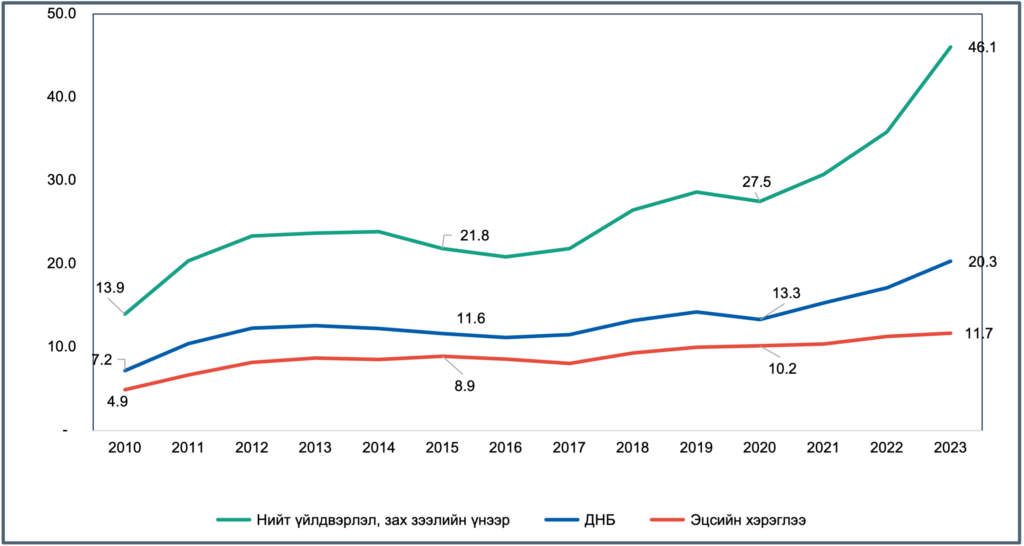
Green:GO in market prices; Blue: GDP; Orange: final consumption expenditure
The vitality and strength of large and small businesses determine the economic status of a nation. Savings by citizens, investments by companies, capacity for innovation, and making products appealing to consumers are the foundations of success. Therefore, economic growth stems from supply-side factors (supply creates demand) as proposed by French economist J. Say (1767-1832), known as the French “Adam Smith”, over 200 years ago. His theory, known as Say’s Law of Markets, suggests that “rapid change and economic growth arise from supply”. Right-leaning and center-right political forces advocate this view.
When Per Capita GDP Reaches USD 10,000…
While presenting the 2025 budget proposal, Prime Minister L. Oyun-Erdene noted that when per capita GDP reaches USD 10,000, the country’s creditworthiness will rise by 1-2 levels, interest rates will drop by up to 30%, foreign investment will increase by 1.5 to 3 times, and infrastructure issues will be resolved. Investments in science and technology will grow, boosting productivity and diversifying the economy. Skilled human recources will return to the country, and foreign experts will begin working in Mongolia. Average wages will rise by up to 60%, household incomes will expand, poverty levels will decrease, and public sector wages will rise, improving governance efficiency. The development of education and healthcare will lead to better quality services, raising citizens’ quality of life and life expectancy.
For all this to become a reality in Mongolia, Say’s Law must be implemented. This involves improving the business environment, ensuring equity, reducing certain taxes, encouraging innovation, gradually privatizing state-owned enterprises, welcoming foreign banks through policy, fostering free competition, establishing justice, reforming the judiciary, and liberalizing prices.
Whether all of this can be achieved by 2028 depends on the government, the parliament, and the well-informed participation of citizens.
The main reason Mongolia has been caught up in a developmental deadlock (traffic congestion, air pollution, poverty, emigration, social inequality, corruption, and the devaluation of the tugrik) thirty years after its democratic revolution can be attributed to the deviation in the distribution of state power. In a democratic state with a market economy, state power is divided into three branches: legislative, executive, and judicial, which must exist in balance and mutual control to ensure social and economic development. However, we have come to a point where it is a semi-presidential, semi-parliamentary system, with the president pulling the strings for the judiciary while the executive branch is all talk and no action.
The judiciary’s actions and decisions have become unclear, and Mongolia faces a severe lack of justice. Court proceedings are often closed to the public, and the reasons for arrests remain shrouded in secrecy, as well as the delays in trials, or acquittals. It has become commonplace for individuals involved in corruption and embezzlement of public funds to evade punishment, manipulate the law, or even behave as though they are triumphant heroes. The grand anti-corruption operations named “the five SH,” have become the “five shush” operations. Crimes such as the SME loans case, the Development Bank fraud, coal theft, and education loan scams have all faded into obscurity.
State-owned companies dominate the economy again, operating at a loss, while oligarchs devour small businesses. Illicit trades for plots of land, buildings, and special licenses flourishes, and housing prices have skyrocketed. Bureaucratic parasites are thriving, while most citizens are succumbing. Free competition has essentially disappeared, and labor productivity has sharply declined. The annual interest rate on bank loans exceeds 20%, pawnshop rates are over 60%, and private businesses are shrinking. Only commercial banks and their owners’ businesses are profitable, while others are going bankrupt. Taxes are increasing significantly, and it is increasingly hard to raise wages. People have lost faith in their government and prefer to go abroad.
Rather than taking urgent action to address these issues and prioritize the protection of citizens’ rights, the support of private businesses, or economic diversification, a series of steps were made to increase the president’s powers and extend his term. Why has expanding the authority of a single individual become so urgent, rather than improving the quality of life for the public? Didn’t we recently amend the Constitution to elect the president for a single six-year term? A group of individuals now seeks to change or invalidate this provision. They are preparing to use the power of parliament to “amend” or the Constitutional Court to “nullify” this clause.
When state power becomes overly concentrated in the hands of one person, it conflicts with public interests, stifles opposing viewpoints, and opens the door to authoritarianism. Who benefits from ignoring such lessons demonstrated by world history and recent examples? When a country is ruled by a single individual, power often shifts to internal factions or external forces, leading to conflict and unrest that can ultimately cost the country’s sovereignty.
The guarantee for Mongolia’s continued development and independence is its parliamentary system where decisions are made collectively, rather than according to the whims of one individual. Instead of weakening this guarantee, shouldn’t we be working to strengthen it? Electing the president through the parliament, as Germany does, could be a solution.
To parties, candidates and voters in Parliamentary elections of 2024 (No:02)
A historic event to determine how we Mongolians will live in the future is approaching. Since it will affect everyone’s lives, it’s time for all of us to participate in the elections. Do not forget that if you don’t show up, someone else will make your choice for you!!!
Attempts to buy state authority!
For the second time in the history of democratic Mongolia, the parliamentary elections are to be held under a mixed system, after twelve years. In the 2024 elections, 78 MPs will be elected from electoral districts, while 48 MPs will be appointed by party lists. The list is to be announced to the public on Monday, May 20.
Therefore, over this weekend, large-scale political deals will likely unfold, involving historically large sums of money for Mongolia. Social media rumors speculate about deals where 2-6 billion tugriks (about 1.8 million USD) are “donated” to parties to secure a spot on their lists, for individuals or their families.
If this happens, the very purpose of increasing the number of MPs by 52, to ensure representation from all social class and parts of the population, will be in vain. Instead of doctors, teachers, engineers, and community leaders, only the wealthy will make it onto the party lists.
The main goal of MPs who bought their way in will be to multiply their wealth, become ministers, secure government tenders, and pass laws and regulations favorable to their businesses. They will not be concerned with citizens’ fundamental values such as freedom of speech, justice, or the opportunity to work hard and thrive.
The story of a system without a fair judiciary will go on, corruption will not decrease. No real improvements will be made in the quality of life and the MNT will keep devaluing with higher prices and more people leaving country.
If the leadership of political parties engage in such deals, Article 1.3.2 of the Constitution will be violated, which prohibits “illegally taking or attempting to seize state power.” Donations by companies and citizens are legally limited to a certain amount. Mongolia has a small population, and it will soon become clear who gave how much to secure their position. They will be almost immediately recognized.
I believe that someday, a fair judicial system will emerge to clarify the truth.
Stability from the get-go for the new government
From past elections, it was clear that when the leader of the winning party becomes Prime Minister, the government is formed quickly without delay, and state affairs continue smoothly. In advanced democracies, the party leader instantly becomes the Prime Minister. Therefore, it is necessary that all parties competing in the election declare that their leader will become Prime Minister. If possible, they should even announce who will be appointed as cabinet members and which ministries they will oversee, as this can also influence votes.
Additionally, it’s time for the public to call on the 29 parties and 2 coalitions to exclude anyone who has been involved in crime, especially corruption, from their lists and government posts. Otherwise, it will be another reason for an instable government.
The time is approaching to choose our politicians wisely.
With the hopes of not ending up in a State capture…
This Defacto World travel story is on Inner Mongolia or Southern Mongolia, as called by Mongolians. The region’s economy, specifically the milk production and consumption, history of Southern Mongolia, and the modern city of Huhhot are elaborated here.
Southern Mongolia is vast region with a land area of 1.2 million square kilometers, bordering Mongolia and Russia. It is one of the five autonomous regions of China. The population is 24 million, with 4 million ethnic Mongolians. The region is rich in natural resources with big deposits of iron ore and coal and even takes the first place in the world for rare earths reserves.
Southern Mongolia has experienced intensive development in the last two decades through its smart use of minerals in supplying the needs of Chinese industries. Its GDP as of the end of 2022 was 344 billion USD and GDP per capita was 14,343 USD.
The number and composition of the herds are similar to Mongolia’s with 32 million sheep, 30 million goats, 4.7 million cows, 4.2 million horses and 900 thousand camels. We visited the world-renowned dairy producer – Yili.
Production and consumption of milk
Milk is an important source of vitamins and minerals, especially calcium. This is why some countries have dedicated milk programs for schoolchildren. The two biggest dairy producers of China are both located in Southern Mongolia. Yili takes up 21% of the whole milk and powdered milk market of China while the figure is 16% for Mengniu.
Yili group was first established in Huhhot in 1957 and underwent a corporate restructuring in 1993 to become a group. A certain percentage of this public company, currently located in the Jinshan Development Zone, is owned by the Huhhot Municipality. In 2008, 290 thousand babies were poisoned and six died due to melamine – a chemical used in plastic production being found in the baby formula produced by this company. After this case, the Chinese government tightened its requirements for food supplies and production exponentially.
In 2019, Yili Group acquired Westland Co-operative of New Zealand, which was established in 1937 and is the third largest dairy producer of the country. The group now has 81 factories and 67,000 employees worldwide, and is one of the top five milk producers in the world. It is China’s biggest producer of milk, powdered milk, baby food, ice-cream, and cheese among many other foods. Yili is now the third best food brand in the world.
China’s milk production reached reach 41 million tons in 2023, showing an of 28 percent compared to 2019. In 2022, China imported 1.5 billion USD worth of milk, being the second biggest importer of milk in the world after the US. Half of the imports were from New Zealand, and the rest from Germany, France, Australia and Poland. Most of the 25 million USD in milk exports that year went to Hong Kong.
The milk consumption amount was 20 million tons for US in 2023 while China consumed 16 million tons. When it comes to milk consumption per person, Finland leads the world with 260kg a year as of 2021. The Chinese, on the other hand consumed 34kg, which indicates the great growth potential in their milk production. Moreover, Mongolians consumed 193kg and Russians consumed 154kg per person in 2021. (ourworldindata.org).
History of Inner Mongolia
Huhhot is home to a major museum, the Inner Mongolian History Musuem. The first floor shows natural exhibits and the 3rd and 4th floors show the historical exhibits.
There is a 1330 map of Yuan Dynasty (1279-1388), established by Kublai Khan, a grandson of Chinggis Khan. The Dynasty spanned an area stretching from Lake Baikal to Ural Mountains. The subsequent dynasty was the Ming (1366-1644), with its map of 1433 on display. To the north of the Ming Dynasty, Northern Yuan existed covering the area of modern Mongolia and Lake Baikal region. In the meantime, the Qing Dynasty (1644-1912) map of 1820 depicts Khalkh and Oirat lands which were subject to the Manchu.
Northern Yuan was a country led by Dayan Khan Batmunkh, who united Mongolic peoples but the country did not last long. According to the historian Baabar, the domain of Northern Yuan covered the lands from Khinggan Mountains to Altai Mountains and from Lake Baikal to the Great Wall of China. The eastern three tumens (peoples) were Tsakhar, Khalkh and Uriankhai. The western three tumens were Tumed, Oirat and Yunsheebu. The Tumed were the strongest group of people and their leader Altan Khan founded Huhhot in the beginning of 1500s. Eventually, the Mongol lands which joined the Manchu Qing Dynasty were called Inner Mongolia whereas the parts which became a dominion with special priviliges were called Outer Mongolia.
Altan Khan spread Buddhism in his domain and commisioned the building of Ikh Zuu or Dazhao temple in 1557. When the temple was completed in 1580, Huhhot grew around it. A large statue of Altan Khan stands in front of the temple. Around the same timeline in 1585, Abtai Sain Khan rebuilt on the old ruins of Karakorum temple and renamed it Erdene Zuu.
About the city of Huhhot
Huhhot is the capital of the Inner Mongolia Autonomous Region. This city with 500 years of history is home to 3.4 million people. Ethnically, the population is 84 percent Han Chinese, 8 percent Mongolian, and others. Administrative divisions include 4 counties, 4 districts and 1 banner.
Huhhot has wide roads with each main road having 3 lanes in each direction complimented by wide bike lanes, surrounding greenery, pedestrian sidewalks, and supporting minor roads. The good planning results in the absence of traffic jams.
The east and south parts of the city were built with a combination of high-rise buildings with modern architectural solutions and large green spaces. The banks of the large river flowing across the south of the serves as a sports and recreation area.
The ger quarters of the city which stood there twenty years ago have been completely replaced by residential buildings. My driver said that the price of one square meter in the apartments is 11000 yuan or 1600 USD, and it can be cheaper in the old city to the west.
Everybody spoke Chinese and some of the Mongolians spoke Mongolian. Twenty years ago, all buildings and streets had Chinese and Mongolian script on them. Food menus had two language versions. Now, however, most writings are in Chinese. In elementary schools, Chinese is taught first and then some Mongolian language lessons follow with few hours allocated to them.
This wraps up my travel stories in Southern Mongolia, a northern region of China bordering our country. I hope it is helpful knowledge for you.
Translated by Munkh-Erdene Davaajav
24.04.30
(A message for those running for office in the 2024 Parliamentary elections)
There are 3.6 million of us, Mongolians. Our population will reach 4 million in 2033. How many of this 4 million will live abroad then? How many of us are currently employed and how many live abroad? What are the main causes of decreased employment and increased emigration as well as the reason behind low return rate among those who moved abroad? What should be done for Mongolians to earn decent income and live quality life in homeland?
Dwindling employment…
As of today, Mongolia is home to 2.1 million people considered to be of working age – aged 15 and over, of whom, 1.2 million or 58 percent are in the labor force, and 893 thousand or 42 percent are out of the labor force (retired, studying, or other). Around 91 percent of the labor force earns an income, while the remaining 9 percent has no income and “does not seem to figure it out (D.J)”. In the meantime, 47 thousand people or 5.2 percent of those who are out of the labor force qualify as having the potential to join the labor force based on factors such as having no job to earn wages or income, actively looking for work in the last 30 days, or ready to work immediately when the opportunity presents). (National Statistical Office – NSO.2022).
Among the 104 thousand unemployed people in Mongolia, 67 thousand are men and 38 thousand are women. 36 percent of the unemployed population have university degrees. The number of unemployed people rose by 3.2 thousand compared to the same period last year. Youth (aged 15-24) unemployment rate is at 18 percent or 19 thousand people. (NSO.2022)
Labor force participation rate (relation between those earning income to the labor force) stands at 58 percent as on 2022. The same figure is 72 percent in Estonia and 70 percent in Singapore. Mongolia had the rate of 65 percent back in 2006. The evaluation for this figure covered 2.1 million people in the labor force whiule excluding certain groups such as those living away from their family, residing abroad, serving the military or being imprisoned.
Rising emigration…
The officials report there to be around 200 thousand Mongolians living abroad. According to the 2024 NSO report, there are 141 thousand citizens (76 thousand women and 65 thousand men) residing abroad for 6 months or more. The number of those “migrants” equal 3 percent of Mongolia’s population with half of them being over 32 years old and having lived abroad for an average of 7.2 years. As for the destinations, 3 out of 10 people live in South Korea, 2 in the United States and Japan, and 5 in other countries.
In 2023, the NSO conducted an analysis on the data of 1865 people living abroad for 6 months or more in countries including South Korea, the US, Japan, Kazakhstan, Czech Republic, Australia, PRC, Germany, Sweden, France, Russian Federation, Turkey, Austria, Switzerland, the UK and others. Broken down to the details, 63 percent of those people are female, 70 percent possess a diploma or higher qualification, 34 percent are single while 40 percent live with their family with 1-3 family members. 85 percent have residence permits and 72 percent have jobs. It was reported that 40 percent of them do not plan to return to Mongolia and 23 percent intend to become a citizen of their country of residence.
Why does this outward flow persist?
The NSO recently published a research report “Emigration of Mongolian Citizens and foreign personal transfers and their impact” conducted among households in Mongolia with a family member living abroad.
44 percent of those moving abroad were for economic reasons, 36 percent for education, and 13 percent for accompanying family members. 80 percent of 15-34-year-old migrants moved to study, while 80 percent of those aged 35 or above moved for work or accompany their families. 40 percent of those moving for work or accompanying family were already employed while in Mongolia. The average monthly income of their remaining households in Mongolia is 1.5 million tugriks, mainly consisting of pensions, allowances, and wages. 4 out of 10 households have no employed members. This clearly demonstrates the issue of low wages in Mongolia and the failure to meet the needs of families.
What now?
Salary is a regular payment made by the employer for the products and services produced by an employee in a certain period of time. Salary is correlated to productivity. Given that all other factors are constant, higher productivity means more value is created and usually beings an increase of wages.
The main condition for labor productivity increase is free competition. In any sector, wages can increase only with free competition or a free market. The competition pushes its losers into bankrupcy. It needs to be noted that the more government involves itself in the economy, the less free competition occurs. It is impossible for a private enterprise to compete with the state. In every country Mongolians choose to go, the government’s participation in the economy is low. The state is a machine that does not create value, but rather distributes it through taxes.
In countries with abundant natural resources and weak citizen participation and oversight, government involvement tends to be excessive. This is even more evident in a country like ours where the economy is entirely dependent on mining.
The basic condition for free competition is free prices. Energy and fuel prices should be bed on competition and fluctuate freely. If not, the product or service will become scarce, out of stock and even disappear. As the “state-controlled price” is set lower than the cost to produce, the producer goes bankrupt. The time has come to transform all state-owned companies into public and joint-stock ones.
Another reason why the wages are low is the high taxes in Mongolia. Our thirty-year old taxes rates are even higher than the centuries-old tax rates set in Western countries where their citizens have mastered the payment of taxes and accessing proper services worth their payment as well as exerting oversight on the government. For decreasing the taxes, the government needs to be small and highly productive. All taxes need to be halved and youth need to be exempt from some taxes completely. Isn’t it the time to put the tax revenue from natural resources to use for helping the citizens get rid of pit latrines through building inexpensive compact homes and renting them out?
To decrease the interest rate of the banks, BoM needs to make the policy rate zero. The main condition for decreasing savings interest rate is the profitability of investing in bonds and shares over saving the money in banks. In order to achieve that, the companies must have credibility and reliability. Again, free competition and transparency are the prerequisites.
To put a halt on the plummeting value of the tugrik, the money made from mining needs to be invested in emerging sectors, particularly preparing young professionals it IT to develop AI-enhanced products. A dedicated program needs to be implemented to enable the novel products to be exported to the global market.
In the agricultural sector, herders need to supported in becoming collectives based on the grazing grounds or bagh units, accessing investment loans to advance in value chain and receiving incentives based on quality over quantity.
A major business opportunity with the quickest export prospect is the three projects to develop international aviation academy, aircraft repairing facility, and pilot training course.
All these efforts are made made possible by foreign investment. Foreign investment comprises foreign money, management and know-how. Of course, they are not missionaries. They come for profits. We need the resourcefulness to attract foreign investment and establish joint ventures and keep the technology as in the example of China.
The NSO report reveals that the emigrants planning a return to Mongolia mostly ask for “improvements in livibality factors and provision of services including healthy and pleasant environment, decreased air pollution, better health, education and social services, robust food security, stable economy”. We, the ones who are currently in Mongolia also need all this.
To lead a prosperous life as a whole family in our homeland, the above-mentioned measures need to be taken at least. Or else, with everyone fleeing, someone might have to say “to the last person leaving, please turn off the lights”.
Us, Mongolians can develop our country and ourselves, rid our government of corruption, and lead a prosperous life based on the free market.
Translated by Munkh-Erdene Davaajav
Ulaanbaatar
2024.04.26
Each provinces of Mongolia, that share border with Russia, has border passage checkpoints, making locals to do trading and traveling more easily under a special program.
One of those checkpoints is Borshoo, located on Uvs province’s northern border with Tuva Republic of the Russian Federation.
A small village on Tuvan side is called Khandgait where Tuva people do trading with Mongolian retailers mostly buying Chinese goods not only to fill domestic needs but also for further re-selling to neighboring Russian regions. In the Khandgait village, there are two major food and every day goods marketplaces as well as three or four cafes where usually Russian customs officers have meal.
Most interestingly, those people who are running retail trading business in those major marketplaces are mainly Mongolians came from neighboring Uvs aimag. They go to China through a border checkpoint at the Bulgan soum of Khovd aimag to do bulk trading and re-export to Tuva, selling goods in one of those two major marketplaces of Khandgait. Goods at the Khandgait markets reach Kyzyl, capital city of Tuva Republic, at almost over priced rate.
This road of cross-border trading, if we, Mongolians, can manage well, could lead to a huge potential of economic growth in the three western aimags by using their geographic advantages.
Population of Tuva is around 330,000, equal to Mongolia Bayan-Olgii, Uvs, Khovd and Zavkhan provinces. It is 1,170km to get to Ulaanbaatar from Ulaangom, a provincial center of Uvs, by air while it takes only 460km to get to the Kyzyl by paved road. Mongolia imports wheat, flour, gasoline, and energy from Russia, but it faces many difficulties to make export to Russia, especially in export of meat.
According to Tuvinsky Express newspaper (March 15, 2010), Russian veterinary authorities banned its import of more than 2,000 breeding animals from Mongolia on the grounds of 70 percent of the breeding animals were found to have “contaminated”. But an official at Tuva authorities has said that it plans to import 65,000 live animals from Mongolia. Anyway, boneless beef is 240 ruble (Russian currency) or US$8 at a central market of Kyzyl city. Same meat is US$3 in Ulaanbaatar while it is US$0.80 in Ulaangom, which shows us business opportunities of potential market there. On one side, meat trading looks profitable, even it has strict requirements to trade, on the other side cross-border thief of animal from Tuva side has no intention to stop.
If Mongolia cooperates with Russian side in veterinary health sector, by building meat plant with European veterinary hygiene standards, there is huge opportunities to do border trading.
In the south, there is huge capacity to produce any consumer goods, while in the north there is big market ready to buy. “Re-export” – supplying Siberian region of Russian Federation with China-made goods, is real moneymaking business we can go into today. Thus, five remote western provinces of Mongolia can join into a regional economic integration.
As a rule of global cross-border trading, supplier side builds major trading marketplaces to attract cross-border traders from other side. In this sense, Davst soum of Uvs province can act as Mongolia’s Erlian.
Development of Mongolia’s re-export of Chinese goods to Tuva can save time and cost for Tuva people because it has no railway, it is more costly for transportation to do further trading with Russians in their west rather than doing business with Mongolians. This is the advantageous side of Mongolia’s remote western provinces.
Clear example of this is Uvs province has organized trade fairs a number times in the past, for which more than 4,000 vehicles lined up from Tuvan side waiting to cross the Mongolian border. Local government of Uvs province has extended periods of the trade fair from two to four days, but Mongolian side has lack of business premises to accommodate those opportunities.
It is urgent to create favorable environment to bolster cross-border trading by building modern facilitated marketplaces, hotels, food and service industries around on the border with Tuva, if we look into its market potentials and further deep into Russian domestic markets. In Tuva, unemployment rate is 28 percent, and economic condition is what we had in the 1990s but there is still huge amount of cash at the hand of Tuva people.
Prior to the establishment of cross-border trading center on the border with Tuva, there is a strict demand to build commercial establishments in Ulaangom in firsthand. A central market in Ulaangom has even yet asphalted, unfortunately, and food is sold at open-air market, where it has rows of cargo containers.
Key to competitiveness is to have high local demand, and high consumer rights requirements. It becomes easier to reach foreign market if domestic demand is fully supplied. Food and service industries need to be improved in Uvs province to accommodate all passenger volumes.
It is time to make a smart move to promote business initiatives of the local people in Uvs province.
Kyzyl-Ulaangom
March 24th, 2010
Highlights of the Week:
1. Chinese Speaker’s visit to Mongolia
2. Commissioning of the Tavantolgoi – Gashuunsukhait railway
3. Draft revision of the investment law introduced
Highlights of the Week:
1. Chinese Foreign Minister visits Mongolia
2. The UN Secretary General visits Mongolia
3. The state of the Eg River Hydropower plant project
Pope Francis press conference at the conclusion of the apostolic journey to Mongolia:
– What was your main purpose of visiting to Mongolia?
– Are you satisfied with your reaching that purpose?